As an Amazon A ssociate, I earn from Qualifying purchases.
It’s frustrating to clean your bathroom until it sparkles, only to find a crusty white layer stuck to the sink. That chalky buildup can make even a spotless bathroom look dirty and old. If you have hard water, you’ve probably seen this before.
Mineral deposits form when water dries up, leaving behind calcium and magnesium. You may need heavy-duty cleaners to remove them, but the fix is usually much more straightforward. You don’t need pricey products—most hard water stains can be cleaned with things you already have at home.
This guide will show you how to clean tough buildup, unclog your aerator, and keep those stains from returning.
Contents
- 1 Why Hard Water Buildup Forms on Faucets
- 2 How to Clean Hard Water Buildup on a Faucet | Step-by-Step Guide
- 3 Best Cleaners for Removing Hard Water Buildup on Faucets
- 4 How to Clean Different Faucet Finishes
- 5 How to Remove Hard Water Buildup from a Faucet Aerator
- 6 How to Prevent Hard Water Buildup on Faucets
- 7 Conclusion
- 8 Frequently Asked Question
Why Hard Water Buildup Forms on Faucets
Before you start cleaning, it’s good to know what you’re dealing with. Hard water has a lot of dissolved minerals, mainly calcium and magnesium. When water splashes onto your faucet and dries, the water evaporates, but the minerals remain.
Over time, these minerals build up into complex layers. You’ll usually notice this in a few common spots:
- The spout: This is where water drips and forms a crusty ring.
- The base: Water pools here, leading to thick deposits.
- Handles and joints: Splashes settle in these crevices.
- The aerator screen: The small mesh filter at the tip of the spout.
Leaving this buildup isn’t just about looks. If it sits too long, the minerals can damage your faucet’s finish. A clogged aerator can also mess up your water flow, causing low pressure or uneven spraying.
How to Clean Hard Water Buildup on a Faucet | Step-by-Step Guide
Want your sink to shine again? This simple method works well, is safe for most finishes, and costs very little.
Step 1: Gather your supplies
You don’t need strong chemicals. Just gather these basic supplies:
- White vinegar (The acidity eats through calcium)
- Lemon juice (An alternative to vinegar)
- Baking soda (For scrubbing power)
- Microfiber cloth or rag
- An old toothbrush
- Paper towels
- A plastic bag and a rubber band
Step 2: The soak method
The key to removing mineral deposits isn’t ’ scrubbing harder. L. Let us do the work for you. Soak a paper towel or rag in vinegar, then wrap it around the faucet to cover the buildup.
- If the buildup is on the spout tip, fill a plastic bag with vinegar, submerge the spout in it, and secure it with a rubber band.
Step 3: Let it sit
Be patient, towel sit for at least 20 minutes. to 30 minutes. to 30 minutes. If the buildup is really tough, rub the debris or break down the calciumor bag. Tvinegareposit shbreak down the calciumld toothbrush to break down the calcium and scrub around the base and handles. If there are still stubborn spots, make a paste of baking soda and water. Apply the paste and give it another scrub. The mild abrasion helps lift the debris without scratching.
Step 5: Rinse and dry
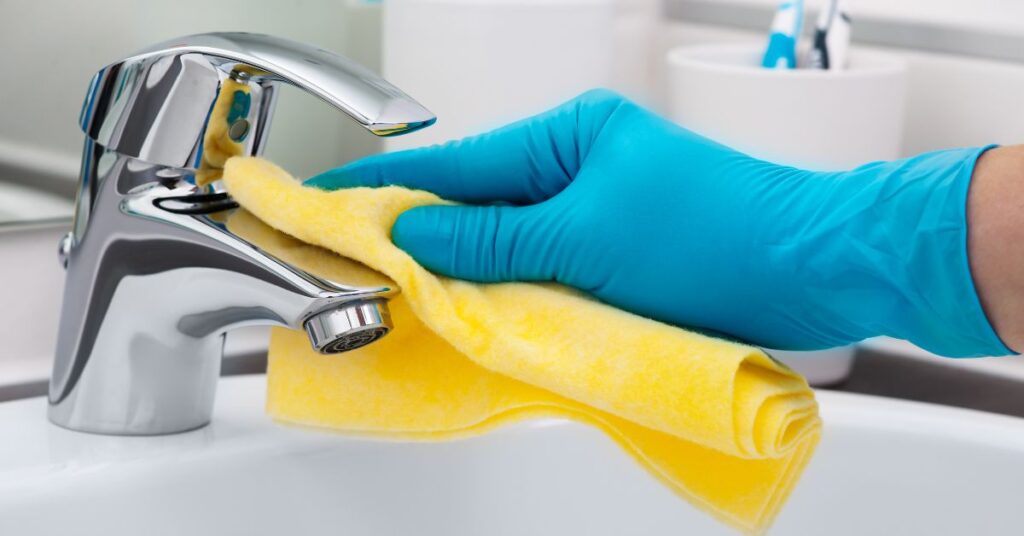
Rinse the area with warm water to remove the vinegar and loosened buildup. Dry the surface right away with a microfiber cloth. If you let it air-dry, water spots will return quickly.
Best Cleaners for Removing Hard Water Buildup on Faucets
Vinegar is the go-to cleaner for most people, but sometimes you might need other options if the stains are really tough.
Natural Cleaners
- White Vinegar: The most versatile cleaner. Its acidity dissolves limescale effectively.
- Lemon Juice or Citric Acid: If you hate the smell of vinegar, lemon juice works similarly. You can cut a lemon in half and rub it directly on the metal.
- Baking Soda Paste: Excellent for scrubbing without being too harsh.
Commercial Cleaners
If natural methods don’t work, try a store-bought limescale remover. Look for products made to remove calcium and rust, like CLR. Always read the label to make sure it’s safe for Chrome or stainless steel.
What to Avoid
You want to clean your faucet, not damage it. Never use:
- Steel wool: This will instantly scratch polished surfaces.
- Harsh abrasives: Avoid scouring powders that are too gritty.
- Acidic cleaners on stone: If your faucet is mounted on marble or granite, be meticulous. Vinegar and acidic sprays can etch natural stone.
How to Clean Different Faucet Finishes
Not all faucets are the same. A method that works for Chrome could harm a matte-black finish.
- Chrome faucets: These are durable. The standard vinegar-soak + microfiber-cloth method works perfectly here.
- Stainless steel faucets: Use vinegar or lemon juice, but scrub along the grain to avoid scratches.
- Brass or matte black faucets: These are delicate. Use a mild mix of equal parts vinegar and water. Don’t soak for too long, and wipe gently instead of scrubbing.
- Gold or specialty finishes: Follow the manufacturer’s instructions. Usually, warm water and mild dish soap are best to protect the finish.
How to Remove Hard Water Buildup from a Faucet Aerator
If your water pressure is low or the stream sprays to the side, your aerator is probably clogged with mineral deposits.
- Remove it: Unscrew the aerator at the end of the spout. If you need pliers, put a towel between the tool and the metal to avoid scratches.
- Soak it: Drop the disassembled parts (mesh screen, rubber washer, housing) into a bowl of vinegar. Let it soak for 30–60 minutes.
- Scrub: Use your toothbrush to clean the mesh screen. You’ll see the small white bits come off.
- Rinse: Run the water through the screen to clear any remaining particles.
- Reinstall: Screw the aerator back on. Turn on the tap and enjoy better water flow.
How to Prevent Hard Water Buildup on Faucets
You’ve worked hard to clean your faucet, so let’s keep it looking good. You might not be able to change your water, but you can change your habits.
- Wipe it down: Keep a small towel nearby and wipe the faucet dry after washing dishes or hands. When water evaporates, it leaves minerals behind. If you wipe it, you remove the minerals before they stick.
- Weekly maintenance: Don’t wait for buildup to appear. Clean once a week with a quick spray of diluted vinegar.
- Install a water softener: The only way to stop hard water buildup for good is to remove the minerals before they reach your tap. A whole-home water softener does this by taking out calcium and magnesium.
- Check the filter: If a whole-house filter is too costly, try a faucet filter to reduce impurities.
Conclusion
You don’t have to put up with a bathroom that looks dirty, no matter how much you clean. As you’ve seen, removing hard water buildup from a faucet is easier than you might think. With some vinegar, a toothbrush, and a bit of patience, you can get rid of even tough calcium deposits.
The best tip is to keep up with routine maintenance. Wiping down your faucet every day stops minerals from building up. But if you get busy and limescale comes back, you now know how to make your fixtures shine again.
Frequently Asked Question
1. What causes hard water buildup on faucets?
It is caused by high concentrations of dissolved minerals, specifically calcium and magnesium, found in hard water. When water evaporates, these minerals are left behind, forming a crusty white layer.
2. Does vinegar remove calcium deposits from faucets?
Yes. The acetic acid in vinegar reacts with the calcium carbonate deposits, breaking them down so they can be easily wiped away.
3. How often should I clean hard water stains from my faucet?
You should wipe the faucet dry daily. For a deeper clean, use a vinegar solution once a week to prevent heavy buildup.
4. Is vinegar safe for all faucet finishes?
Vinegar is safe for Chrome and stainless steel. However, for matte black, brass, or gold finishes, you should dilute the vinegar or use mild soap, as acid can sometimes damage delicate coatings.
5. How do I stop hard water buildup permanently?
The most effective way to permanently stop the issue is to install a water softener, which removes the minerals from your water supply before they reach your fixtures.
As an Amazon A ssociate, I earn from Qualifying purchases.